
Starting & Charging Tech Tips
- Glossary of Terms
- Battery Visual Inspection and Testing
- Charging System Helpful Tips
- Starter System Helpful Tips
Add-on Regulator - Some alternators use an add-on type regulator that is mounted on the outside of the alternator housing.
Alternator - A belt-driven device that creates electrical current for maintaining the charge state of the battery and the electrical requirements for the vehicle.
Ampere - Commonly referred to as amps, this is an electrical unit of measure. Alternators are rated by the amp output capacity at a given voltage.
Battery - An electrical storage device used to supply electrical current for starting a vehicle.
Charge Lamp - A light in the vehicle instrument cluster that illuminates when the alternator is not charging, or when there is a fault in the charging circuit.
Core - This is the old unit being removed from the vehicle.
Diode - Diodes are used in pairs (positive and negative) to change the alternator output from alternating current (AC) to direct current (DC).
Direct Drive Starter - This type of starter has a the drive gear attached to the armature or utilizes the armature as the drive gear.
External Fan (EF) - This alternator design has a fan mounted on the outside of the alternator that directs air flow across the internal components for cooling.
External Regulator (ER) - Some alternators use a voltage regulator that is not attached to the alternator. It is usually found on the fender well.
Flywheel - This is a large gear mounted to the back of the crankshaft, which turns the engine when the starter is cranking.
Internal Fan (IF) - This alternator design has two fans built together with the rotor inside the alternator that directs air flow across the internal components for cooling.
Internal Regulator (IR) - Some alternators use a built-in type regulator that is mounted on the inside of the alternator housing.
Offset Gear Reduction Starter (OSGR) - This type of starter uses an internal gear set used to increase torque. The internal gear sets are offset, which means the drive gear and motor rotate on different axes.
Permanent Magnet Starter - This type of starter uses magnets for magnetic poles rather than coils of wire (field coils). These units are lighter in weight and smaller in size.
Planetary Gear Reduction Starter (PGR) - This type of starter is similar to the Offset Gear Reduction, however the gear sets are not offset, which means the drive gear and motor rotate on the same axis.
Rectifier - This is an electrical component in the alternator that contains sets of diodes, which are used to change the alternator output from alternating current (AC) to direct current (DC).
Solenoid - This is an electrical switch on the starter that, once energized, allows the starter to engage the drive gear into the flywheel during starting.
Starter - This is an electrical motor that cranks the engine by moving a drive gear into the flywheel, thereby rotating the crankshaft.
Starter Drive - This is the gear on the starter that engages the flywheel, causing the engine to crank.
Voltage Regulator - This is an electrical component used to maintain the proper charge state of the battery by regulating the alternator output.
The following general information has been assembled as a guide for battery inspection and testing. Refer to the appropriate Original Equipment Manufacturer’s service manual for specific information pertaining to battery inspection and testing procedures, and safety precautions for your vehicle.
Before performing any electrical system diagnosis or repair, make sure the battery has been:
- 1. Visually inspected.
- 2. Fully charged.
- 3. Performance tested.
Visual inspection
Before the performance test can be conducted, it is necessary to inspect the battery for visual defects and adjustments.
1. Make sure the battery is the proper size and type for the vehicle application. Compare each of the following characteristics to the vehicle manufacturer’s specifications:
- Cold Cranking Amps (CCA) rating
Note: The cranking amps (CA) rating is different than the CCA rating.
- Physical size and mounting style
- Post orientation
2. Make sure the battery does not have loose posts, and the case is not cracked, bulging, or showing signs of leaking fluid.
3. Make sure the battery surface is free of dirt and moisture.
4. Make sure the battery connections are clean and corrosion free. This includes the frame and body ground connections, and the connections at the starter motor, starter solenoid, and alternator.
5. Make sure the battery cables are properly sized.
6. Make sure the battery cables have no frayed wires, and the insulation is intact.
7. Make sure the battery cables are flexible and bend freely. Popping or crackling sounds while bending the cables indicate corrosion. Replace the cables.
8. Check the electrolyte solution if the battery has access. Add enough distilled water to maintain the electrolyte level just below the filler tube.
9. Check that the battery is properly secured, and the mounting hardware is not too tight.
Charging and Performance testing
Before the performance testing can take place on the battery, a visual check must be done to determine if the battery’s physical condition is adequate for proper operation.
1. If the electrolyte solution has been adjusted during the visual inspection, charge the battery for 15 minutes at 15 to 25 amps.
2. Charge the battery to obtain at least 12.6 volts (full charge). After charging the battery, apply a 150-amp load for 10 to 15 seconds to remove any surface charge. Check the open circuit voltage. If 12.6 volts or above is not measured, replace the battery and continue to evaluate the charging system.
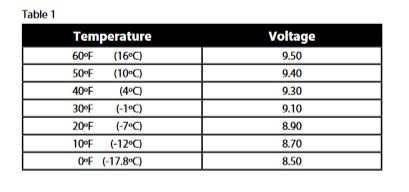
3. If the open circuit voltage is 12.6 volts or above, load-test the battery. A good battery will be capable of producing one-half of its CCA rating for 15 seconds and maintain a voltage reading of 9.6 volts (adjusted at 70º F) or above (Table 1). Perform the load test twice, waiting approximately 30 seconds between tests.
4. Check for parasitic loads at the battery. An excessive parasitic load can drain the battery in a short period of time. Draws in excess of 0.35 amps should be investigated. Refer to the Original Equipment Manufacturer’s service manual for the parasitic load specification for your vehicle.
- What is the condition of the battery?
-
A visual inspection and performance test of the battery must always be performed before inspecting the charging system. The battery must be fully charged (12.6 volts), and the battery cables, terminals, and case must be in good, clean condition. This includes the frame and body grounds as well (refer to Battery Visual Inspection and Testing).
- Does a charge lamp, amperage (amp) gauge, or voltmeter indicate a charging system problem?
-
Charge Lamp:
- Ignition ON and engine not running The charge lamp should illuminate.
- Ignition ON and engine running - The charge lamp should illuminate briefly then turn OFF.
- Weak Battery - A weak battery can cause the charge lamp to illuminate during high amperage draw.
- Low Idle - A low idle can cause the charge lamp to illuminate dimly.
- Poor Wiring - Corroded, broken, loose, or frayed wires/connections could cause the charge lamp to illuminate during idle.
- Open Charge Lamp - Some charging systems will not properly operate if the charge lamp bulb fails.
Amp Gauge:
- Ignition ON and engine not running - The amp gauge should read zero or slightly below.
- Ignition ON and engine running - The amp meter should display a current output above zero. It will display a different level of charge, depending on what electrical circuits are operating. A negative charge indicates the battery is discharging more quickly than the charging system can supply current.
- Wires and connectors - Corroded, broken, loose, or frayed wires/connections could cause zero or erratic readings on the gauge.
- Ignition ON and engine not running - Gauge readings should be between 12.0 and 12.6 volts with the ignition ON and the engine not running. Readings below 12 volts could indicate insufficient charging, low battery, or corroded, broken, loose, or frayed wires/connections.
- Ignition ON and engine running - Gauge readings should be between 13.0 and 14.5 volts with the ignition ON and the engine running. A reading exceeding 14.5 volts could indicate a bad battery, failed regulator, or poor wire connections. A reading below 13.2 volts could indicate a failed alternator or corroded, broken, loose, or frayed wires/connections.
Voltmeter:
- Are any fuses open?
-
Check the fuses in all the fuse box(es). An open fuse indicates circuit problem(s) that may have an effect on the charging circuit. Check the owner’s manual or the manufacturer’s service manual for the location of each fuse box.
- Is the fusible link(s) open?
-
There may be several fusible links controlling battery voltage to the vehicle’s electrical circuits. If a fusible link is open, supply voltage will be completely lost to all electrical systems or to the electric circuit(s) that the open fusible link controls. Check the owner’s manual or the manufacturer’s service manual for the location of each fusible link.
- Is the alternator’s drive belt tension within specification?
-
Too loose - If the drive belt is too loose, it will slip around the pulley, causing the alternator to charge irregularly or not at all.
Too tight - If the drive belt is too tight, internal bearing damage will cause premature alternator failure.
- Is the alternator’s drive belt in good condition and the proper size?
-
Worn or too narrow - If the alternator’s drive belt is worn or too narrow, it will slip around the pulley, causing the alternator to charge irregularly or not at all.
New drive belt - The life of a new alternator drive V-belt is approximately 10 minutes. It is important to check and adjust the belt’s tension to the “used” specification after the initial 10 minutes of operation. This will not apply to serpentine belts.
- Has the vehicle been modified or additional equipment installed after it left the factory?
-
Accessories - Non-factory accessories, such as phones, computer outlets, televisions, refrigerators, stereo equipment, or lights, among others, can overburden alternator performance and cause premature failure.
Improper accessory installation - Improper accessory installation procedures can cause charging problems. Some of these problems may include poor ground points, loose connections, or improper wiring.
- Has any work been performed on the vehicle? Electrical ground points
-
Electrical ground points - Check the ground circuits between the battery and engine, and also from the vehicle body to the frame for high resistance. Many times when a vehicle has been repaired, the ground point(s) are disturbed or not resecured properly.
Multiple electrical grounds - With multiple ground vehicles, each electrical circuit is assigned to one or more ground points. A poor ground at one ground point may cause feedback through another ground point, causing unusual circuit activity.
- Does the starter turn the engine too slowly?
-
- The battery must be fully charged (12.6 volts), and the battery cables, terminals, and case must be in good, clean condition. This includes the frame and body ground connections, and the connections at the starter motor and starter solenoid. (Refer to Battery Visual Inspection and Performance Testing).
- Advanced engine timing will produce combustion forces working against engine rotation. These forces will be transmitted to the starter during starter engagement, reducing its performance capability.
- Excessive engine oil viscosity, particularly in cold weather environments, will reduce the ability of the engine to rotate. This increase in engine drag will be transmitted to the starter during starter engagement, reducing its performance capability.
- Engine modifications change the operating characteristics of the engine. If modifications are performed, a chance of additional forces acting against the starter will be introduced. The starter should be replaced with the one matched to the new operating characteristics of the engine.
- Does the starter turn without turning the engine?
-
- The flywheel or flex plate transfers the rotational energy of the starter to the engine. If the starter is turning but not the engine, check all teeth on the flywheel/flex plate to see if they are excessively worn, damaged, or missing. Inspecting the flywheel/flex plate teeth can be performed through the starter mounting port if an inspection plate is not available.
- A failed starter drive assembly could produce similar symptoms as a damaged flywheel/flex plate. If the starter pinion meshes properly with the flywheel/flex plate and does not rotate, the starter should be inspected for mechanical wear or damage.
- Does the starting system click when activated?
-
- If clicking is heard when activating the starter control circuit, and the starter does not turn, the solenoid may not be receiving the voltage necessary to be fully activated. Check the starter control circuit for failed or damaged components and wiring, and loose, dirty, or corroded connections.
- If the solenoid is receiving proper voltage, the solenoid may have burnt contacts. Follow the vehicle manufacturer’s recommended procedures and safety precautions to inspect the solenoid.
- Is there a clattering noise when trying to start the engine?
-
- Clattering may be associated with physical damage to the flywheel/flex plate. Inspect the flywheel/ flex plate completely for cracks, dents, roundness balance, etc.
- An inoperable starter solenoid or a damaged starter may also cause clattering. Follow the vehicle manufacturer’s recommended procedures and safety precautions to inspect the solenoid and starter.
- The battery must be fully charged (12.6 volts) and the battery cables and terminals in good, clean condition. This includes the frame and body ground connections and connections at the starter motor and starter solenoid. (Refer to Battery Visual Inspection and Performance Testing).