Tech Tips
- Why Converters Fail?
-
Most catalytic converters fail due to engine related problems. Replacing the catalytic converter without fixing the cause of the failure may lead to another ruined converter.
Common causes of failure:
Most catalytic converter failures are caused by conditions or events other than converter malfunction:
- Melted or rattling brick: usually caused by raw fuel entering the converter and superheating the substrate.
- Contaminated brick: oil, antifreeze, or fuel additives coat and plug up the substrate, preventing the converter’s chemical reaction from taking place.
- Road damage: caused from road debris striking the converter and causing internal damage.
- How Come My Car Has California Emissions, When I Don’t Live There
-
Even if you’re not located in California, you may have California emissions-equipped cars come into your shop. Here are some facts that you need to know when dealing with the exhaust systems for California cars that are registered outside of California:
When it comes to vehicle emissions, there are two regulating authorities: U.S. Environmental Protection Agency (EPA) which governs the Federal law throughout the country and the California Air Resources Board (CARB), which governs emission laws in the state of California and 13 additional states that follow CA emissions laws. However, only California applies its stringent regulations to the use of aftermarket replacement converters.
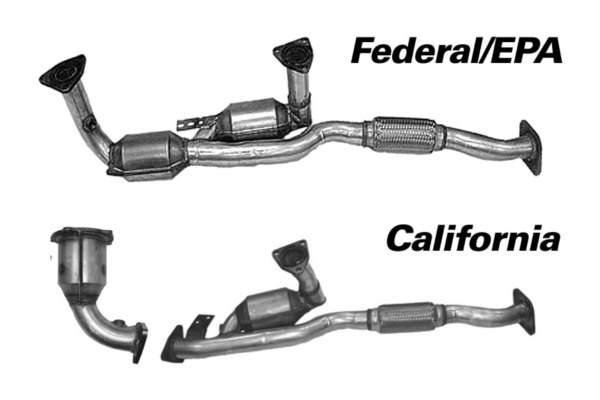
So what kind of converter can you use as a replacement in the other 13 states? With so many variables, it may be difficult to know unless you can determine if a vehicle was built to meet federal or CA emissions. Look at the picture below
Both of these systems are listed for a 2000 Nissan Maxima.
However, only the one below fits a CA emissions vehicle. It has three Oxygen sensors and a different configuration.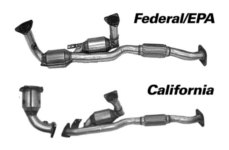
A common misconception is that a Federal converter can be used on any vehicle not registered in California. However, this only applies to vehicles with Federal systems. If the vehicle has a California system, it must use a converter made for that system. While the converter does not have to legally meet CARB aftermarket emissions standards, it must meet the “mechanical” conditions of the system. This is important because the converter configuration, length and Oxygen sensor locations may be different in the CA car.
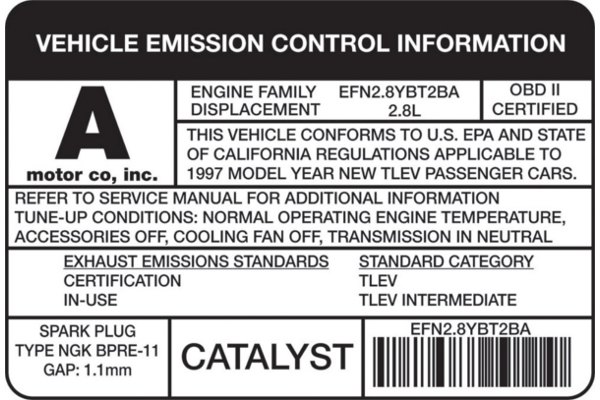
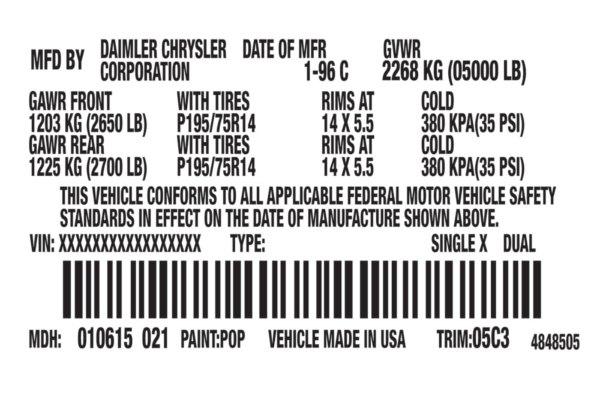
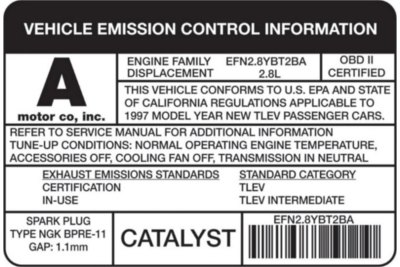
Vehicle emissions systems labels
To properly determine whether the vehicle requires a CA or Federal converter, you should check the vehicle’s emissions system label.
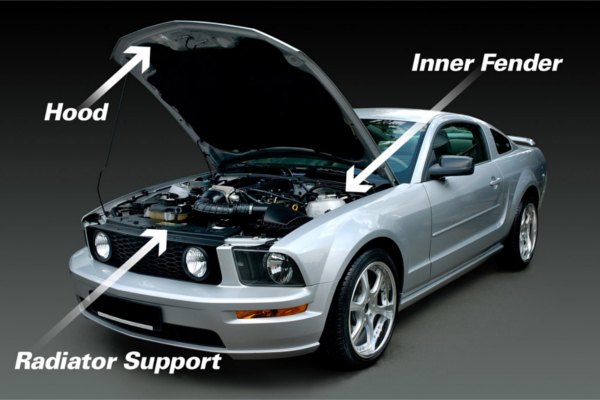
 Emissions label locations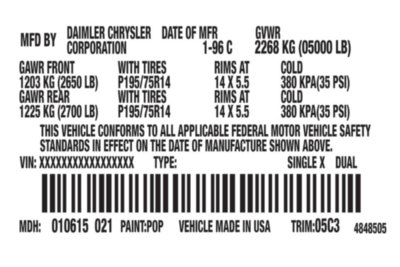
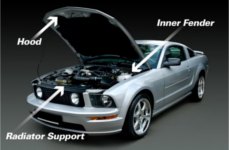
Common vehicle emissions label locations are:
- On the front radiator support
- On the strut tower plate
- Under the engine hood