
Clutch Fan Installation
- Installation Tips
- Tutorial
Installation Tip 1
Service Bulletin: Repeated Failures of New Water Pumps Multiple failures of new or rebuilt water pumps on the same vehicle when the failure appears to be bearing or seal related should perform the following: Closely inspect and replace the fan clutch if visible movement of the shaft in a vertical or horizontal direction is noted when checked by physically applying pressure to the fan blade in a front to back direction with the vehicle turned off and the battery disconnected. When the fan blade freely rotates when physically turned by hand while the vehicle is turned off with the battery disconnected. When the fan clutch shows signs of fluid leakage at the front thermal pin area located in the center front of the fan clutch or at the rear shaft and bearing area.
Installation Tip 2
Service Bulletin: Repeated Failures of New Fan Clutches Multiple failures of New Fan Clutches on the same vehicle when the failure appears to be bearing, seal or shaft separation related should perform the following: Closely inspect and replace the water pump if visible movement of the shaft in a vertical or horizontal direction is noted when checked by physically applying pressure to the fan blade in a front to back direction with the vehicle turned off and the battery disconnected.
Installation Tip 3
Service Bulletin: Transmission Oil and Filter Change When changing your transmission fluid and filter note the color of the fluid. If the fluid is brownish in color and smells like burnt toast the vehicle could be experiencing transmission overheating. Every 20 degrees Fahrenheit decrease in fluid temperature can double the life of the fluid and transmission components. Protect your vehicles transmission - install a Hayden Transmission Oil Cooler. The addition of a Hayden cooler can lower your transmissions temperature by up to 60 degrees Fahrenheit. Three times the amount required to double the life of your transmission.
Installation Tip 4
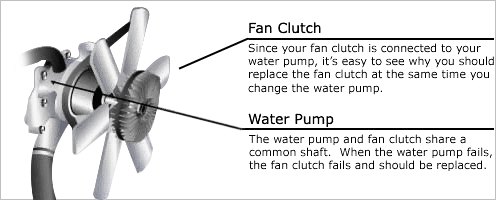
When changing your water pump it is a good idea to change the fan clutch at the same time. Both share a common shaft and have the same life expectancy.
What is a Fan Clutch and How Does it Work?
The fan clutch is a coupling between the water pump shaft and the fan that allows the fan to be operational at low speeds and disconnected at higher speeds. The fan clutch is important, because it allows the engine to operate more efficiently by removing the load that the fan places on it, and cools the engine when cooling is needed.
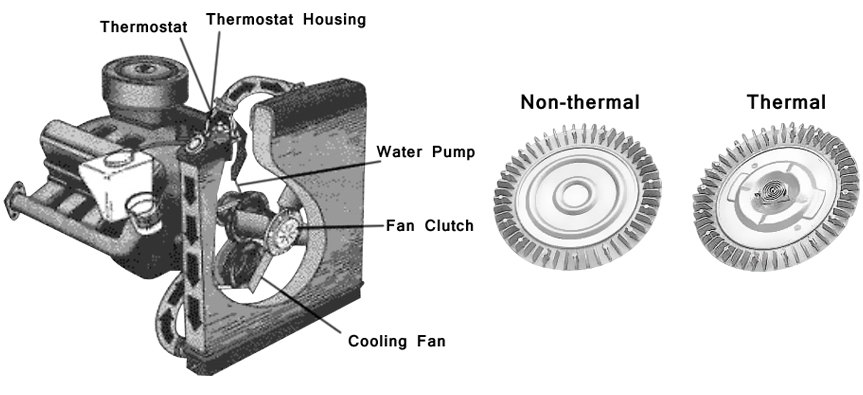
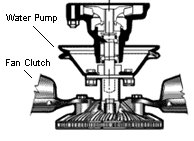
It is important to note that since the fan clutch and water pump share a common shaft, the operation of one will affect the operation of the other. If the bearing in the fan clutch wears out then the fan will wobble. The vibration from the wobbling fan blade will be transmitted to the water pump bearing which will cause it to wear out quickly. On the other side of the coin, a worn water pump bearing will cause the bearing in the fan clutch to wear out (again, due to the transmitted vibrations). If this water pump is replaced without replacing the fan clutch, then the worn fan clutch will cause the new water pump to fail. That is why it is very important that the water pump and fan clutch be replaced together.
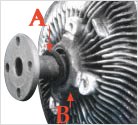
'A' shows a failed bearing, while 'B' shows a silicone fluid leak.
Two Types of Fan Clutches
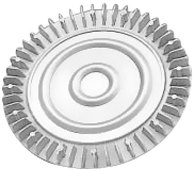
Non-thermal. Non-thermal clutches operate based on the shaft speed of the water pump. At low and idling speeds the clutch allows the fan blade to turn at almost a 1:1 ratio. At high speeds the silicone fluid contained in the clutch will lose its ability to transfer the energy from the shaft to the fan clutch body (and therefore the fan) and the fan is then allowed to almost free-wheel, removing its load from the engine.
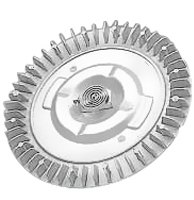
Thermal. The thermal fan clutch is a little more sophisticated and operates, as the name implies, in response to underhood temperatures. When the engine is cold, the fan is disconnected; when too much heat is generated, the fan is allowed to cool the engine. A bi-metal thermostatic coil mounted at the front of the clutch senses the underhood temperature and operates the clutch accordingly.
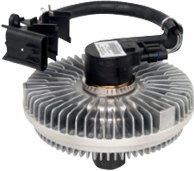
Electronic - Viscous EV Fan Clutch Operation
The ECM/PCM signal controls the level of engagement of the EV clutch. An internal solenoid opens a spring loaded valve which allows silicone drive fluid to flow from the storage reservoir to the working area of the unit engaging the clutch. This engagement process is ultimately controlled through the ECM/PCM by the following input variables: Coolant Temperature, Intake Manifold Temperature, Transmission Oil Temperature, A/C Pressure and Engine Oil Temperature. These variables are manufacturer specific and fan speed is dictated based on the level of cooling required. Please consult the Original Equipment specifications to determine which set of variables apply to your vehicle.
Electronic-Viscous Fan Clutch Troubleshooting
During engine start up, the EV fan clutch will engage and match engine speed for up to 3 minutes. This is considered normal and may last more than 3 minutes in cooler climates or at lower driving speeds resulting in fan roar. This condition will cease shortly upon disengagement. Additionally, you may hear an audible “clicking” sound when the vehicle is stationary. These conditions are normal and should cease once the fan clutch disengages.
IMPORTANT:
- Do NOT replace EV fan clutch unless a specific issue is identified by proper SI (Service Indicator / Check Engine) diagnosis.
- Do NOT replace an EV fan clutch for fan noise.
- Do NOT replace an EV fan clutch unless a specific condition related to the EV fan clutch is identified using SI diagnostics. If the EV fan clutch has a condition that warrants replacement, a DTC (Diagnostic Trouble Code) should set and/or SI diagnostics should lead to the replacement of the fan clutch.
- Do not attempt to replace EV Fan Clutch without proper tools. Please refer to manufacturer requirements for proper tools and replacement.
Replace the Fan Clutch and Water Pump at the Same Time
How to Detect a Faulty Fan Clutch
- Fan spins excessively when engine is stopped.
- Poor A/C performance at idle or low vehicle speeds.
- Fan speed does not increase when engine is hot.
- Fan speed does not increase until engine is excessively hot.
- Fan blade tip moves more than 1/4” front to back.
- Fan turns roughly or does not turn at all.
- Excessive fan noise at all speeds due to failed bearing.
- Vibration that increases with engine speed.