
Exhaust Systems
- About Exhaust System
- Exhaust System 101
- What is Exhaust System?
-
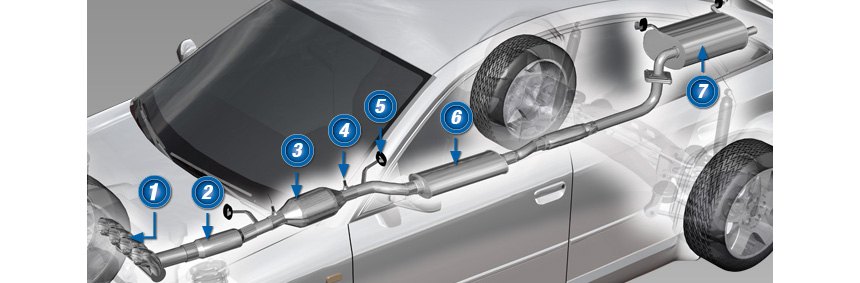
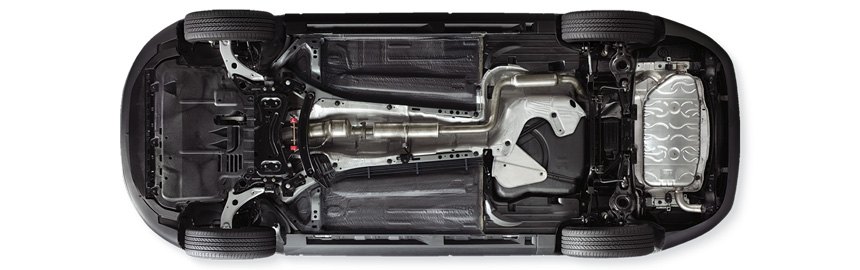
An exhaust system is a complex automotive parts assembly that performs a series of critical emissions functions.
- 1. Manifold. Typically made of cast iron or fabricated tubing, it sometimes incorporates the catalyst, and is connected to the engine at the exhaust ports with flange connectors. It is designed to collect exhaust gases from each cylinder, then funnel them into a common outlet.
- 2. Flex Pipe. Allows normal engine movement to prevent damage to the exhaust system.
- 3. Catalytic Converter. Converts harmful engine emissions to CO2 and water.
- 4. O2 Sensors. Detect the level of O2 in the exhaust stream. This information is utilized by the PCM for fuel control, and to monitor converter efficiency.
- 5. Isolators, Gaskets, Clamps. Required accessories for proper sealing and durability.
- 6. Resonator Assemblies. Resonator assemblies combine pipe routing and tuning technologies for quality flow and acoustics.
- 7. Muffler Assemblies. The muffler quiets the sound of a vehicle's engine as emissions pass out of the exhaust system.
An exhaust system must:
- Carry engine exhaust gases safely to the rear of the vehicle
- Reduce the engine sound level
- Maintain engine performance
- Reduce or eliminate certain engine emissions
- Why do Exhaust systems wear out?
-

Most exhaust system deterioration occurs primarily from the inside out. The exhaust system is one of the very few parts on a vehicle that continues to wear even though the engine is not running and the vehicle is stopped.
MANY FACTORS CAN AFFECT THE LIFE OF A VEHICLE'S EXHAUST SYSTEM
- Uncontrolled environment (weather, temperature, road condition)
- Vehicle usage
- Condition of exhaust components within the system
- Manufacturer's materials
A MAJOR CAUSE OF FAILURE FOR EXHAUST SYSTEM PARTS IS INTERNAL CORROSION
- Acidic moisture is produced by the combustion of air and gasoline
- Acid build-up occurs when the engine and exhaust system don't have a chance to fully warm up
- Because these acids are in contact with the inside of the exhaust system, the deterioration of these parts occurs primarily from the inside out
- Reasons to Require Exhaust Replacement
-

Many wear factors mandate exhaust system replacement to control harmful emissions and maintain safe vehicle operation.
WEAR DEFECTS REQUIRING VEHICLE EXHAUST SYSTEM REPLACEMENT INCLUDE:
- Pipe leaking
- Body shell distorted, affecting performance or structural integrity
- Corrosion hole
- Missing component(s)
- Cracked or broken mounting brackets
- Puncture (other than a drain hole)
- Rattling or knocking noise from muffler
- Open or split seams (exhaust leaking)
- Leaking flexible couplers
- Plugged converter
- Reasons to Suggest Exhaust Replacement
-
- Part is close to the end of its useful life
- Address a customer need, convenience or request (eliminate noise, performance upgrade, etc.)
- Comply with maintenance recommended by the vehicle's Original Equipment Manufacturer (OEM)
- A technician's recommendation, based on substantial and informed experience
- The Chemistry of the Exhaust Gases
-
Gasoline engines are fueled with two chemical compounds, gasoline and air. Basically, gasoline is made of two elements, hydrogen (H2) and carbon (C). In the form of gasoline, these two chemicals combine to make what we call a hydrocarbon (HC). Air is made up of basically two elements, oxygen (02) and nitrogen (N2).
If gasoline engines burned their fuel as efficiently as possible, they would produce three by-products: water vapor (H2O), carbon dioxide (CO2) and nitrogen (N2).
For the most part, none of these chemical compounds are harmful; however, environmentalists argue that excessive amounts of carbon dioxide promote the formation of the greenhouse effect. Nonetheless, H2O, CO2 and N2 are the most desirable by-products of combustion, and automotive engineers strive to create emission control systems that allow a vehicle to produce only these three chemical groups.
Unfortunately, engines do not run perfectly, and as a result they also produce three by-products commonly referred to as the "terrible trio" of automotive pollutants. This trio includes the following:
- Carbon monoxide (CO) - is an odorless, tasteless, poisonous gas that can cause a variety of health problems and even death. Many urban areas experience critically high levels of carbon monoxide, especially during the cold winter months when engines take longer to warm up and run cleanly
- Unburned hydrocarbons (HC) - cause a variety of respiratory problems, crop damage, and promote the formation of smog
- Oxides of nitrogen (NOx) - like unburned hydrocarbons, cause respiratory problems, and promote the formation of smog
- Sound Level
-
CONTAINMENT
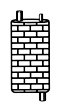
Containment reduces the transmission of sound waves by confining them. Almost any material can help contain sound; the denser it is, the better it works. Many economy mufflers silence exhaust noise by containing the flow of exhaust gases. This is typically not desirable. When exhaust gases are contained, the backpressure increases and vehicle power, performance and fuel economy suffer.
ABSORPTIVE DEVICES

Absorptive devices convert sound energy to heat energy. Sound waves collide with material that flexes and vibrates easily. The material absorbs the sound rather than passing it on as resonance, or bouncing it back toward the source. Sound is reduced by a loss of energy when the absorptive material is moved. This device is more effective on high frequencies. Glasspack type, or glass fiber filled mufflers are an example of sound reduction by absorptive control.
REACTIVE DEVICES

Reactive devices reduce, change, or eliminate noise by reflecting sound waves back toward the source.
Louvered Tubes. One common application of a reactive sound device is the louvered tubes found on the inside of most mufflers. The main purpose of these tubes is to steer sound waves against each other and use their energy to cancel each other out.
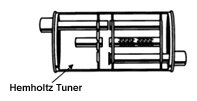
There is one variation of reactive sound control that provides us with a device that reduces low frequency exhaust noise. This device is referred to as the Hemholtz tuner. The Hemholtz tuner operates on the theory that when sound waves pulse through a constricted area into a large closed area, the sound energy will be reduced. This action causes a reduction in the low frequency noise of the exhaust gas pulsations.
In a muffler, the Hemholtz tuner is the large empty "chamber" that typically does not have an outlet. This "room" is there to reduce the low frequency noise from the exhaust system.
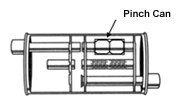
A pinch can is another example of a reactive device used to control sound. This device works on a theory that is the opposite of the Hemholtz tuner theory. A pinch can takes sound waves and forces them into a confined area. As the sound pulsation is exposed to the restricted area, the pressure level of the pulsation decreases. This act of "pinching down" the sound energy, serves to eliminate high frequency noise from the exhaust. Most mufflers utilize some type of pinch can within the muffler.
- Emissions
-
How does an Catalytic work?
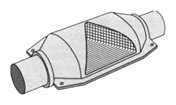
Contained within the stainless steel shell of an aftermarket converter lies a substrate "brick" that is coated with a combination of platinum, palladium, and rhodium. These three elements are frequently called precious, or noble, metals. Hot exhaust gases containing the "terrible trio" (carbon monoxide, oxides of nitrogen and hydrocarbons) of pollutants travel through the exhaust pipe and eventually come in contact with the precious metals that are loaded on the converter's substrate. The substrate is a honeycomb of small ceramic passageways. When the exhaust gas comes in contact with the precious metals or catalyst, a chemical reaction takes place that weakens the bonds of the polluting chemicals and allows them to easily convert into the more desirable by-products of combustion.